
BASIC FIRE SAFETY COURSE
Photography Masterclass: Your Complete Guide to Photography. The Best Selling Online Professional Photography Class: How to Take & Sell Photos.
Overview
Basic Fire Safety Course
INTRODUCTION TO FIRE SAFETY
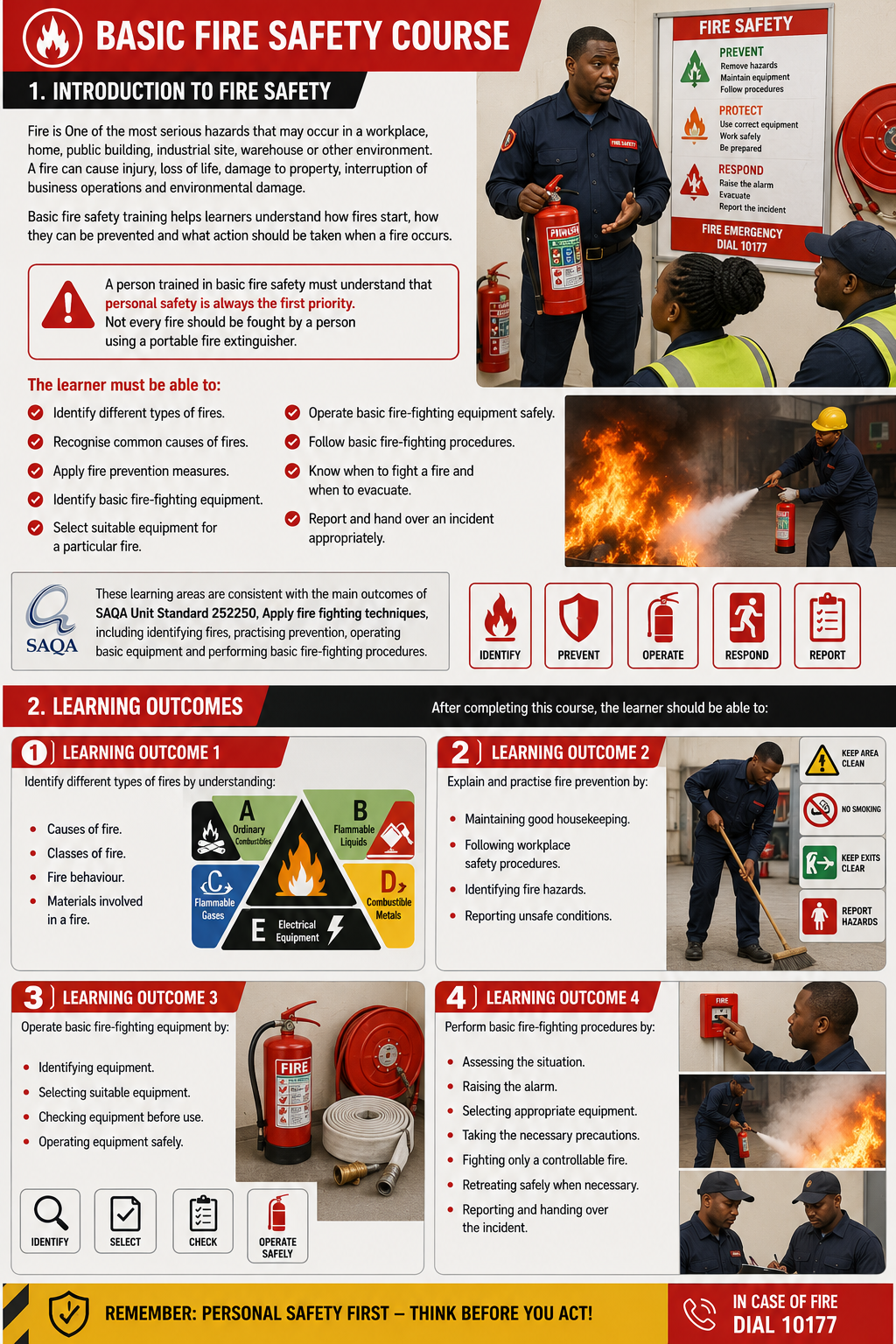
Fire is One of the most serious hazards that may occur in a workplace, home, public building, industrial site, warehouse or other environment. A fire can cause injury, loss of life, damage to property, interruption of business operations and environmental damage.
Basic fire safety training helps learners understand how fires start, how they can be prevented and what action should be taken when a fire occurs.
A person trained in basic fire safety must understand that personal safety is always the first priority. Not every fire should be fought by a person using a portable fire extinguisher.
The learner must be able to:
- Identify different types of fires.
- Recognise common causes of fires.
- Apply fire prevention measures.
- Identify basic fire-fighting equipment.
- Select suitable equipment for a particular fire.
- Operate basic fire-fighting equipment safely.
- Follow basic fire-fighting procedures.
- Know when to fight a fire and when to evacuate.
- Report and hand over an incident appropriately.
These learning areas are consistent with the main outcomes of SAQA Unit Standard 252250, Apply fire fighting techniques, including identifying fires, practising prevention, operating basic equipment and performing basic fire-fighting procedures.
- LEARNING OUTCOMES
After completing this course, the learner should be able to:
Learning Outcome 1
Identify different types of fires by understanding:
- Causes of fire.
- Classes of fire.
- Fire behaviour.
- Materials involved in a fire.
Learning Outcome 2
Explain and practise fire prevention by:
- Maintaining good housekeeping.
- Following workplace safety procedures.
- Identifying fire hazards.
- Reporting unsafe conditions.
Learning Outcome 3
Operate basic fire-fighting equipment by:
- Identifying equipment.
- Selecting suitable equipment.
- Checking equipment before use.
- Operating equipment safely.
Learning Outcome 4
Perform basic fire-fighting procedures by:
- Assessing the situation.
- Raising the alarm.
- Selecting appropriate equipment.
- Taking the necessary precautions.
- Fighting only a controllable fire.
- Retreating safely when necessary.
- Reporting and handing over the incident.
Curriculum
- 13 Sections
- 55 Lessons
- 10 Weeks
- MODULE 15 Items
- MODULE 27 Items
- MODULE 35 Items
- MODULE 47 Items
- MODULE 54 Items
- MODULE 68 Items
- MODULE 71 Item
- MODULE 81 Item
- MODULE 93 Items
- MODULE 104 Items
- MODULE 115 Items
- MODULE 124 Items
- MODULE 131 Item
Instructor

Students List
You May Like

3.1 BEGINNING A SHIFT
3.1 Beginning a Shift The guard should: Report on time. Receive a briefing. Check equipment. Read the occurrence book. Review post orders. Receive information about...

UAE SECURITY SYSTEMS ENGINEER COURSE
A WordPress LMS Plugin to create WordPress Learning Management System. Turn your WP to LMS WordPress with Courses, Lessons, Quizzes & more.

SECURITY MANAGER COURSE
SECURITY MANAGER COURSE Comprehensive Professional Learner Manual UAE / Dubai-SIRA Aligned Professional Training Programme IMPORTANT REGULATORY NOTICE This learner manual is designed as a comprehensive...

Security Systems Technician
This course is a detailed and easy tutorial to get you all setup and going with the use of LearnPress LMS Plugin. It is a...

SECURITY SUPERVISOR COURSE
AI is no longer science fiction. This course will show you what exactly AI is, how it works, and more importantly, how you can harness...

Course Features
- Lectures 55
- Quiz 0
- Duration 80 hours
- Skill level All levels
- Language English
- Students 45
- Certificate No
- Assessments Yes